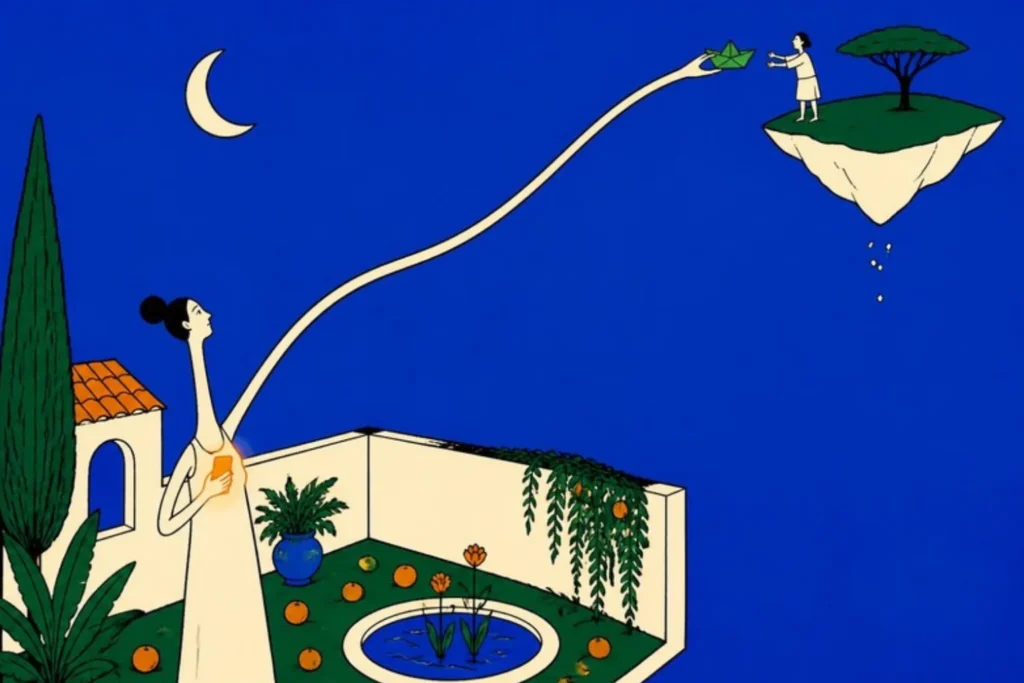
You are on the sofa on a Tuesday. He is reading, you are scrolling, and neither of you has said anything for 40 minutes. A thought arrives uninvited: we used to talk until 2am. Where did we go?
The early months had a pull to them. You checked your phone for his name. You remembered every word he said. Now you know exactly how he loads the dishwasher, and nobody’s heart races about the dishwasher.
- The early rush of falling in love settles within one to three years for most couples. The settling is normal.
- What replaces it, companionate love, predicts long-term happiness far better than the rush.
- A 20-minute daily conversation about life outside the relationship keeps the friendship alive.
What happened to the spark
The early rush runs on novelty, uncertainty and a flood of reward chemistry in the brain. The psychologist Dorothy Tennov, who studied romantic obsession, described it settling within one to three years for most people. The settling is the body returning from a sprint.
What replaces the rush matters more. Psychologists call it companionate love: deep affection, trust, shared jokes and the steady sense of being on the same side. Economists John Helliwell and Shawn Grover found the wellbeing benefit of marriage roughly doubles for people who describe their spouse as their best friend.
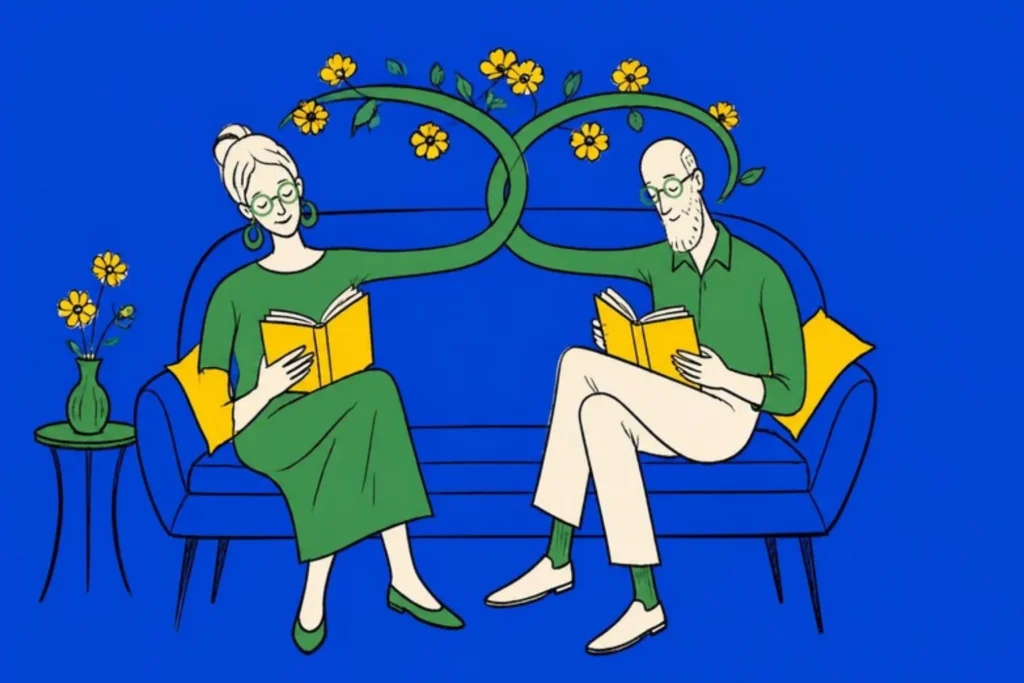
Why couples miss the shift
Many couples read the end of the rush as the end of love. One partner starts to wonder whether the relationship has died. The other feels the doubt and pulls back to protect himself. Each reads the other’s distance as proof.
Other couples drift into a flat companionship with no friendship in it. They share a house, a calendar and children, and stop asking each other questions. Companionate love needs curiosity to stay alive. Without it, the quiet on the sofa turns from comfortable to lonely. Tap each card.
If the spark has gone, the love has gone.
Myth
If the spark has gone, the love has gone.
The spark is a phase. Friendship, trust and shared meaning predict long-term happiness far better than early intensity.
Good couples don't have to work at it.
Myth
Good couples don't have to work at it.
Long-lasting couples practise small daily habits of attention, often without naming them.
Companionate love means no more desire.
Myth
Companionate love means no more desire.
Desire often grows in couples who feel known and safe. Friendship and erotic aliveness support each other.
Which love are you living in right now?
Five questions. Answer for the last month, not the best month.
The 20-minute conversation
Once a day, for 20 minutes, sit down without phones and talk about life outside the relationship: work, friends, the thing which annoyed you on the train. The listener’s only job is to be on the speaker’s side. No advice unless asked. No defending the boss. Questions such as “what was the worst part?” and “what did you want to say to him?” keep it moving.
The practice comes from the work of couples researcher John Gottman, and it builds the friendship many long-term couples lose without noticing. Try it for 14 days, then review together: what did you learn about each other which you didn’t know before?
When friendship is not the missing piece
If you feel afraid of your partner, if sex happens under pressure, or if one of you keeps a secret life, companionship exercises are the wrong tool. Those situations need individual support, a sex therapist or the National Domestic Abuse Helpline (0808 2000 247) first. If an affair has broken trust, start with Stay, Pause or Leave before working on closeness.
Questions for the next 20 minutes

Understanding Conflict Workbook: Work and Relationships
For your next conversation
1002 Questions for Couples
A ready supply of questions for the daily 20 minutes, so neither of you has to think of what to ask after a long day.
Questions people ask
What is companionate love?
Companionate love is the deep affection, trust and friendship which grows after the early rush of falling in love settles. Research links it more strongly to long-term happiness than passionate love.
Is it normal for the spark to fade in a relationship?
Yes. The intense early phase settles within one to three years for most couples. Couples who build friendship and daily attention report higher satisfaction long after the rush ends.
How do you keep a long-term relationship happy?
Daily conversations about life outside the relationship, regular shared laughter, curiosity about each other and quick repair after arguments all support lasting companionate love.
- Helliwell, J. F. and Grover, S. (2014). How’s Life at Home? New Evidence on Marriage and the Set Point for Happiness. NBER Working Paper 20794. nber.org/papers/w20794
- Tennov, D. (1979). Love and Limerence: The Experience of Being in Love. Stein and Day.
- Gottman, J. M. and Silver, N. (2015). The Seven Principles for Making Marriage Work, revised edition. Harmony.
More on this topic: relationship workbooks.