
It is twenty past two on a compound off King Fahd Road. His phone lit up on the kitchen counter, and now you know. Outside, the security light by the pool clicks on and off. In six hours you will walk the children to the school bus, past the neighbour who runs the book club, the one whose husband works on his team.
Your sister is asleep in London. Your closest friend here knows him too. Before any of the big questions about the marriage, a smaller one arrives and will not leave: who do I tell?
- Telling one person well matters more than telling many people fast. Choose for discretion, distance and steadiness.
- On a compound or in a tight expat circle, news travels. Start with someone outside his work world.
- If you are afraid of your partner, or your phone or money is being watched, go straight to the safety section below.
Why isolation hits harder in Riyadh
Expat life in Riyadh often grows around one employer. Housing, school places, medical cover and the social calendar frequently run through one contract. The people closest to you are often his colleagues and their partners. The friendships are real. They are also tangled.
After betrayal, the body reads this tangle as danger. Your chest tightens at the gate barrier. You rehearse a normal face before the coffee morning. Sleep comes in pieces, and the phone feels hot in your hand. These are signs of a nervous system on alert with nowhere safe to put down what it carries. They are not proof you are coping badly.
Shame tends to arrive next. Shame for moving here, for relying on his sponsorship, for missing the signs. Put responsibility where it belongs. The affair was his choice and his to account for. Living far from home shaped your support network. It shaped none of his decisions.

Choose your first listener with care
You need one person, not an audience. Look for three qualities: discretion, distance from his workplace and your shared circle, and the steadiness to listen without steering you. Pick the option closest to your situation.
Who feels right for a first conversation?
Distance protects your privacy. Book a call for an hour when you are both awake, rather than messaging at 2am. Tell them what you need from the call: listening, not advice. Ask them to keep the news to themselves, including from mutual friends online.
Choose someone outside his company and outside the school group chats if you are able. Meet somewhere private, away from the compound. Share the fact, not every detail. You are free to say more later. Taking words back is much harder.
A therapist offers confidentiality bound by a professional code, and has no stake in your social world. Online sessions fit around school hours and time zones. Check the therapist’s registration with their professional body and ask how they protect privacy on video calls. Rules on practising across borders differ, so ask them directly how they work with clients in Saudi Arabia.
A script for the first conversation
When you sit down with the person you chose, say this once, before any details:
I found out something about my husband tonight and I need to say it out loud to one person. I am not asking you to fix it or to take sides. Please keep this between us, including from anyone at his work.
The script names your need, sets a boundary, and protects your choices for later. Whatever you decide about the relationship, you keep control over who knows.
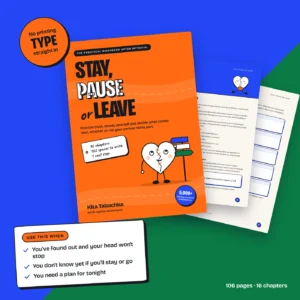
The Steady chapter of Stay, Pause or Leave: The Practical Workbook After Betrayal is the place to begin in these first days, before any decision about staying or leaving. The workbook page for expats in Riyadh covers the same ground with life in the Kingdom in mind. If your partner refuses to take part, using a betrayal workbook alone shows how to work through it on your own.
A fictional example
Leila is a composite, not a real person. She lived on a compound in the north of Riyadh, and her husband’s manager lived three villas away. She found the messages on a Thursday night. Her first instinct was to knock on the door of the neighbour she saw every morning. She waited. On Saturday she called her cousin in Toronto at an hour when both were awake and used the script almost word for word. The following week she booked an online session for the hour after the school bus left. Nothing was decided. For the first time in days, she was not holding it alone.
Practical checks before bigger steps
If separation crosses your mind, slow the decision and speed up the advice. In Saudi Arabia, residence, children’s travel, custody and money each follow their own rules. Your position as a dependant on a spouse’s residence permit depends on your nationality, religion, where you married and who sponsors you. Speak to a lawyer licensed in Saudi Arabia, and contact your own embassy, before you sign anything, move money or travel with the children. This page is education, not legal advice.
When education is not enough
If you are afraid of your partner, if your phone, passport or money is being watched or controlled, if there has been violence or a threat of it, or if you are thinking of harming yourself, stop reading and reach for help now.
In Riyadh, call 911 in an emergency. 999 also reaches the police and 997 the ambulance service. The family protection reporting line run by the Ministry of Human Resources and Social Development answers on 1919, free and around the clock. Its services are mostly in Arabic, so your embassy is a second route for urgent help. The Ministry of Health psychological support line is 920033360. If your phone is monitored, call from a friend’s phone or a work line, and clear this page from your browsing history.
Kita Tabachka is a BACP registered relational therapist (registration 409623) who works online with individuals, couples and expats.
Questions people ask
Should I tell friends on my compound about my partner's affair?
Start with one person outside your shared circle where possible. Compound life is close, and news reaches workplaces and school gates fast. You keep the choice to tell more people later, once you know what you want.
Is it normal to feel this alone after an affair as an expat?
Yes. Distance from family, a social life tied to one employer and different time zones all deepen isolation after betrayal. Feeling alone reflects your circumstances. It is no measure of your strength.
Does online therapy work for expats in Riyadh?
Many expats use online therapy for its privacy and because sessions fit around school hours and time zones. Check registration and privacy, and ask the therapist how they work with clients in Saudi Arabia. Kita Tabachka works online with individuals, couples and expats.
- Ministry of Human Resources and Social Development. Family Protection Department, reporting centre toll free 1919. hrsd.gov.sa
- Expatica. Emergency numbers and services in Saudi Arabia. expatica.com
- Expat Focus. Saudi Arabia: mental health. expatfocus.com
- Snyder, D. K., Baucom, D. H. and Gordon, K. C. (2007). Getting Past the Affair. Guilford Press.
Your next step today: write down the name of one person outside his work world, and send them a message asking for a call at an hour when you are both awake.