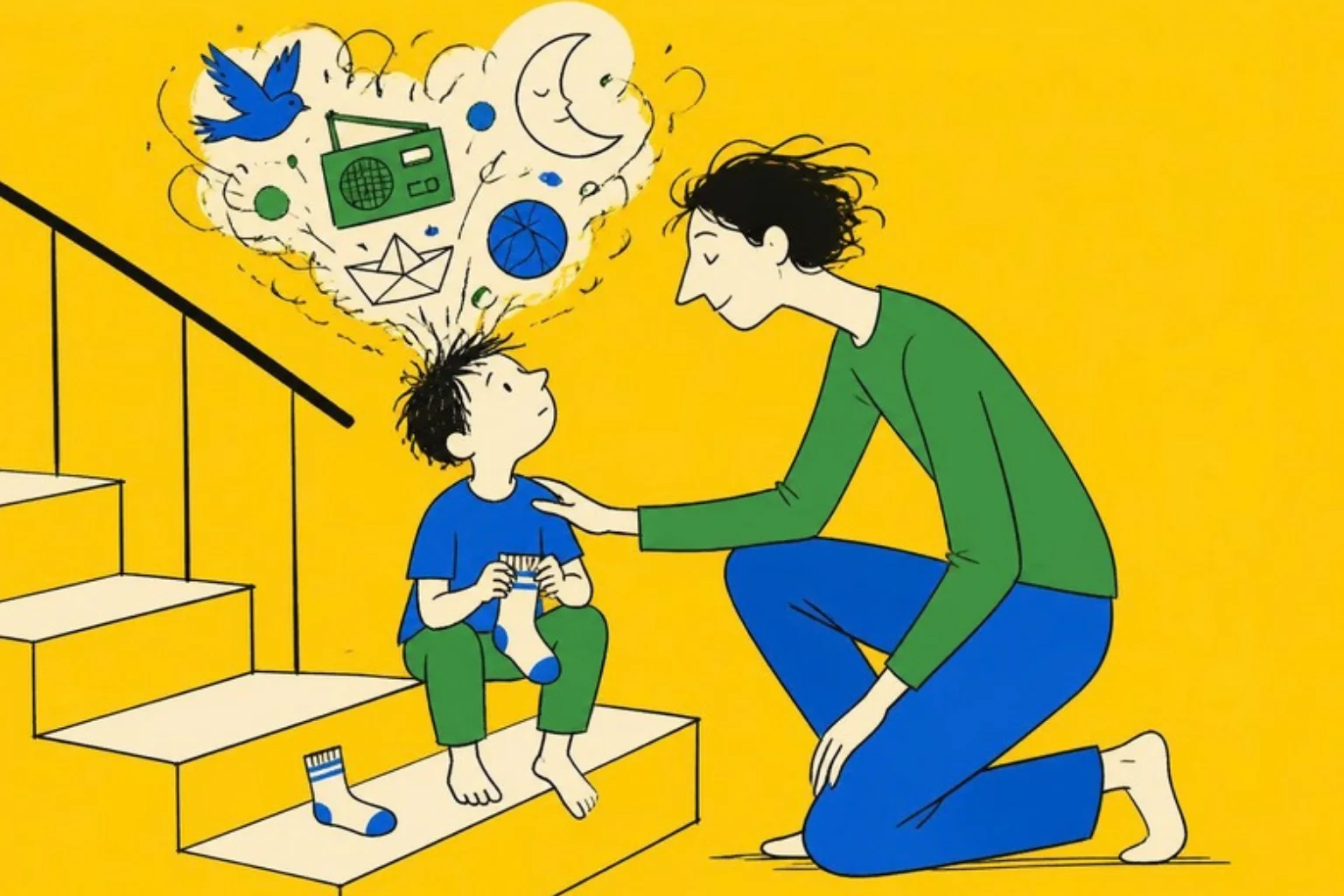
It is 7.52am. School starts at 8.30. You asked your daughter to put her shoes on ten minutes ago, and she is sitting on the stairs holding one sock, looking at the wall. You hear your own voice rise: “Why do you never listen?”
Her face closes. She puts the sock on very slowly. In the car, neither of you speaks.
- Children with inattentive ADHD often describe a head full of noise, not an empty one.
- The quiet presentation is easy to miss, and girls receive a diagnosis later than boys on average.
- One instruction at a time, a picture checklist and repair after the shouting change the mornings.
What it feels like from her side
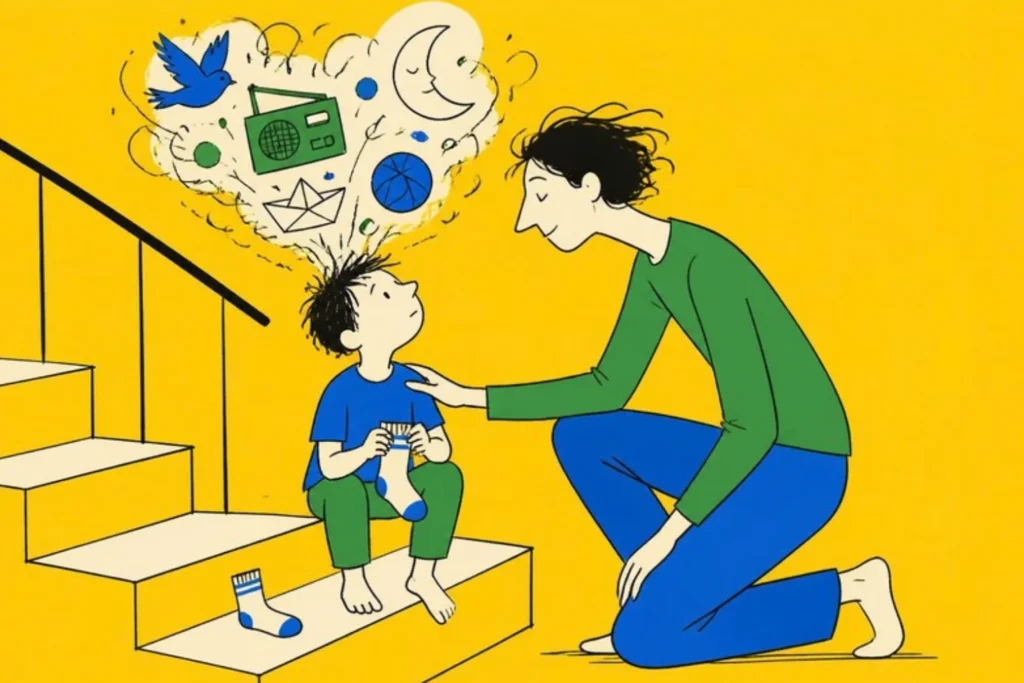
Children with inattentive ADHD often describe the inside of their head as busy. Your instruction arrived. So did the sound of the radio, a thought about a dream, the pattern on the wallpaper and a worry about a friend. The sock in her hand was part of a plan she lost halfway through.
She wanted to hold onto your words. Her attention slipped away from her, the way it slips every morning, and then your voice got loud. What she learns from the moment is rarely “put shoes on faster”. She learns: I am the problem.
Why inattentive ADHD gets missed
The hyperactive presentation of ADHD tends to get noticed, because it disrupts the classroom. The inattentive presentation is quiet. These children daydream, lose things, start tasks and leave them unfinished, take longer to process instructions and drift off in conversation. Teachers often describe them as lovely but somewhere else.
Girls receive an ADHD diagnosis later than boys on average, and many reach adulthood before anyone names it. By then, a lot of them have spent years believing they are lazy, stupid or careless. Tap each card for what the child is living through.
She never listens.
What you see
She never listens.
She heard the first word. Five other things arrived in the same second, and your instruction lost the race.
He loses everything.
What you see
He loses everything.
The coat came off while he was thinking about something else. He has no memory of the moment, so he has no idea where to look.
She's in a world of her own.
What you see
She's in a world of her own.
Her world is louder and more interesting than the worksheet. Staying with the worksheet takes enormous effort, and the effort is invisible.
Signs worth writing down
No article diagnoses your child, and these signs overlap with anxiety, hearing problems, sleep problems and dyslexia. Note how often you see each one over a month:
- Seems not to hear when spoken to directly, even with no distractions
- Loses school things, coats and water bottles every week
- Starts homework and drifts off within a few minutes
- Forgets multi-step instructions after the first step
- Takes much longer than peers over routine tasks such as dressing
- Says things like “my brain is too noisy” or “I’m stupid”
Your protection and hers
Parents get loud because they are frightened: of lateness, of a school phone call, of a future where their child struggles. Your shouting makes sense. It still teaches her to feel ashamed of something her brain does without her permission.
Where is your morning going wrong?
Give one instruction at a time, at her eye level, with your hand on her shoulder. Ask her to say it back. “Shoes on” said once at eye level works better than “shoes, coat, bag, teeth” called up the stairs.
Put a picture checklist by the front door: shoes, coat, bag, water bottle. Point to it instead of repeating yourself. Her eyes do the remembering, and your voice stays calm.
Build ten extra minutes into the morning, so the clock stops running the relationship. Ten minutes earlier to bed for you is cheaper than a morning of shouting for both of you.
Repair after the shouting
You will still lose your temper some mornings. Repair matters more than perfection. Later the same day, when you are both calm, try:
“This morning I shouted at you about your shoes. I was worried about being late, and I took it out on you. Your brain works differently, and you weren’t being naughty. I’m sorry. Tomorrow I’m going to try the picture list. Will you help me make it?”
Then watch her face. Children who receive repair learn their parent’s love survives a hard moment. For adults and teens with the same wiring, read ADHD executive functioning strategies.
Getting an assessment
If the signs show up both at home and at school for more than six months, speak to your child’s teacher and the school SENCo, and book an appointment with your GP. In the UK, the usual route is a referral to CAMHS or a community paediatrician, and waiting lists are long, so start early. If your child talks about hating herself, hurting herself or not wanting to be alive, contact your GP the same day, or call 999 in an emergency.
Downloads for this

Gratitude Journal for Kids: Editable Canva Template

ADHD Mental Health Worksheets and Planner

For calm evenings together
Gratitude Journal for Kids: Editable Canva Template
Short, picture-led pages for five quiet minutes at bedtime, so the day ends on what went right rather than on the morning’s shouting.
Questions people ask
What are the signs of inattentive ADHD in children?
Common signs include daydreaming, losing things, forgetting multi-step instructions, unfinished tasks and seeming not to listen. These signs overlap with other conditions, so a professional assessment is needed.
Why is inattentive ADHD missed in girls?
Inattentive ADHD is quiet and rarely disrupts a classroom, and girls often mask their struggles by working harder or staying out of trouble. Many receive a diagnosis in adolescence or adulthood.
How do I talk to my child about ADHD?
Describe it as a different way the brain handles attention, not a flaw. Use calm moments, keep it short, and repair after conflict so your child links ADHD with understanding rather than shame.
- NICE (2018, updated 2019). Attention deficit hyperactivity disorder: diagnosis and management. Guideline NG87. nice.org.uk/guidance/ng87
- Young, S. et al. (2020). Females with ADHD: An expert consensus statement taking a lifespan approach. BMC Psychiatry, 20, 404.
More on this topic: ADHD and focus articles.