
The planner cost £24 and has a ribbon. Week one is filled in, in two colours. Week two has Monday. Week three is blank, and the planner has moved from the desk to the shelf to the drawer, where the other three planners live.
- Planners fail in ADHD because they ask the struggling executive functions (working memory, initiation, time perception, self-monitoring) to run the system.
- Move the memory into the environment: a page on the fridge, an alarm with a name, a timer you see from the sofa.
- Shrink the first step until it is smaller than the resistance, and run one strategy for one week.
ADHD executive functioning strategies fail for one reason more than any other: they ask the part of the brain which is struggling to run the strategy. The planner was never the problem. It was the wrong tool for the job it was given.

How ADHD-proof is your system?
Five questions about the system you have now, not the one you mean to build.
Four jobs the planner gave your brain
Each one is an executive function, and ADHD affects every one of them. Tap a card for the swap.
Remember to open it
Working memory
Remember to open it
Working memory in ADHD holds less and drops it sooner. The swap: stop relying on it. One page on the fridge, an alarm with a name, a timer you see from the sofa. Put the information where your eyes already go.
Decide what to write
Task initiation
Decide what to write
A blank page is a decision, and decisions cost more in ADHD than the tasks behind them. The swap: a pre-printed page with three boxes and a fixed time to fill them. Filling beats composing.
Guess how long it takes
Time perception
Guess how long it takes
Most ADHD estimates are half the real figure. The swap: track one week honestly, then double every estimate until the numbers match. A wrong plan you trust is worse than no plan.
Check back later
Self-monitoring
Check back later
The planner asks you to return to it, which is the function it was meant to replace. The swap: body doubling. A friend on a video call doing their own work changes nothing about the task and everything about whether you check in.
Which one is yours?
The planner lives in a bag or a drawer. Move the whole system to a wall. One sheet, one week, at eye height in the kitchen. Working memory does not need to remember a page it walks past six times a day.
Blank space is the enemy. Use a page with boxes already labelled: three tasks, one appointment, one thing to eat. The executive functioning worksheets are built this way, with the deciding done in advance.
The writing was the reward and the brain moved on. Pair the page with an existing habit: it sits under the kettle, or on the laptop lid, and gets read while the water boils. The habit you already have carries the one you are building.
Novelty ran out, which it does by day three in most ADHD systems. Shrink the system to one strategy for one week, then swap in another. A new strategy each Monday keeps the novelty, and the weekly planner pages give you a fresh page to swap to.
Shrink the first step until it is smaller than the resistance
The document has been called Untitled for nine days. ‘Write the report’ is not a task, it is a project, and a project has no first step to start. ‘Open the document and type the title’ takes forty seconds. Once the title exists, the second step appears on its own. Task initiation in ADHD responds to the size of the first step more than to the importance of the whole.
A three-column board helps here: to do, doing, done. One card per task, one task in the doing column at a time. Moving a card is a small physical reward, and the done column is the evidence your brain forgets to keep.
Say this instead
The way a task is written decides whether it starts. Tap each one.
Sort out the tax return.
Find last year's P60. It is in the blue folder.
A first step with a location. The next step appears once the folder is open.
Reply to emails.
10am and 3pm: answer the three oldest, then close the tab.
A time, a number and an end. Forty checks a day become two.
Exercise more.
Shoes by the bed. Tuesday 7am, twenty minutes, the park loop.
Pre-commitment does the deciding the night before, so 7am has nothing to decide.

Run one strategy for one week
Not ten. One. Pick it, put it in front of you, run it for seven days, then keep it or drop it. Four to start with.
Colour-coded keys
Colour-coded keys
Every key, fob and card gets its own colour, and the colours live on one hook by the door. Finding the right key becomes a colour match, not a search.
Two email checks a day
Two email checks a day
Ten and three. Outside those, the tab is closed. Forty checks a day cost roughly ninety minutes of refocusing time, which is a project's worth of attention spent on nothing.
Time tracking for one week
Time tracking for one week
Write the start and stop time of everything for seven days. Not to improve anything yet, only to see where the hours went. Most people find one leak worth two hours a day.
Pre-commitment
Pre-commitment
Pay for the class in advance. Put the running shoes by the bed. Tell one person the deadline. The decision is made once, in a calm moment, so 6am has nothing to decide.
The people who make progress do not have better systems. They have fewer, and they test them one at a time.
Teenagers have the same brain with less say over the environment
A fifteen-year-old cannot move the fridge, so the adults around them build the environment: a launch pad by the door, a homework timer on the table, one page of strategies chosen together rather than a whole binder handed over. The strategies are identical. The person setting them up changes.
Downloads for this
A fictional example
Tom bought a planner in January and a second one in March. Both had a beautiful first week. What worked in the end was a whiteboard by the kettle with three items on it, a phone alarm which said what to do rather than the time, and a rule of starting the task for two minutes before deciding whether to do it.
Where this stops
These are strategies, not treatment. ADHD is diagnosed by a clinician, and medication decisions belong with a prescriber. If planning problems come with low mood, anxiety or trouble at work which nothing shifts, an assessment is the better next step than a fourth planner.
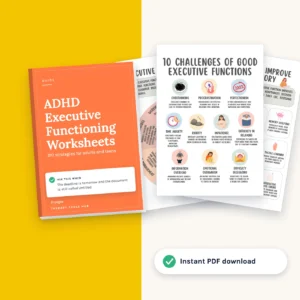
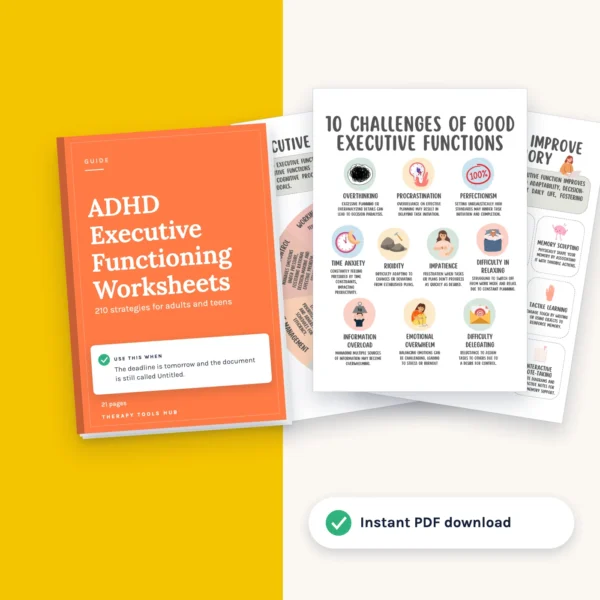
210 ADHD Executive Functioning Worksheets for Adults and Teens
ADHD Mental Health Worksheets and Planner
ADHD Journaling Workbook: Focus Through Writing
DBT Skills Worksheets for Teens: 140+ Page Bundle
The worksheets for this
210 ADHD Executive Functioning Worksheets for Adults and Teens
210 strategies across the eight components of executive functioning, in printable steps for adults and teens.
Questions people ask
What are the executive functions affected by ADHD?
Working memory, task initiation, inhibition, time perception, planning, organisation, self-monitoring and emotional regulation. ADHD affects each to a different degree in each person. A planner draws on at least four of them at once, which is why planners fail more often than the people using them.
Why do planners not work for ADHD?
A planner asks you to remember to open it, decide what to write, estimate how long tasks take and check back later. Those are the exact functions ADHD weakens. Systems which work move the remembering into the environment (a page on the wall, a named alarm, a visible timer) and shrink each task to a first step under a minute long.
What is body doubling?
Body doubling is working alongside another person who is doing their own work, in the room or on a video call. Their presence changes nothing about the task and a great deal about whether you start it and stay with it. It replaces self-monitoring, which ADHD weakens, with an external cue.
Do ADHD strategies work without medication?
Environmental strategies help with or without medication, and many people use both. Medication changes how available attention is. Strategies change how much attention a task demands. Speak to your GP or specialist about medication. The strategies here need no prescription and work from the first week.
- Barkley, R. A. (2012). Executive Functions: What They Are, How They Work, and Why They Evolved. Guilford Press.
- Brown, T. E. (2013). A New Understanding of ADHD in Children and Adults: Executive Function Impairments. Routledge.
- NHS. Attention deficit hyperactivity disorder (ADHD): living with. nhs.uk
More on focus: ADHD worksheets.