
You bought the book. You read the first chapter at the kitchen table and put it down where your partner would see it. Three days later it has moved to the shelf, spine in, and the conversation you were hoping it would start has not happened.
- Most of the work after betrayal is yours alone anyway: what you know, what you need, what you will do. None of it needs the other person in the room.
- A partner who will not engage has given you information. Write it down as information, not as a verdict on your worth.
- Start with one page: what I know, what I need, what I will do. Everything else follows from those three lines.
A betrayal workbook alone sounds like half a tool. It is not. The pages people picture with two chairs, the apology, the agreement, the conversation, come late in the process and depend on everything before them. What comes before them is yours: sorting fact from fear, working out what you need, deciding what you will do next. A partner who refuses to take part cannot stop any of it. They have declined their part, which is a different thing from taking yours.

Which kind of not taking part?
Refusal comes in shapes, and each one points somewhere different. Tap the one closest to yours.
What does the refusal look like?
The apology happened, once, and it has become a wall. This is the most common shape I see. The page for it is page 39, The moment after the apology. An apology which cannot be returned to is a full stop, not a repair. Write what the apology covered and what it missed, and keep the list for yourself.
Silence is an answer. Not the one you wanted, but usable. Record it with the date. Then ask yourself the question the silence forces: what would I need to see, over the next month, to believe change is possible? If nothing comes to mind, the blank is information too.
Agreement is cheap and change is visible. Stop collecting promises and start a change log: date, what was agreed, what you saw. Page 51, Record change without becoming a monitor, keeps you out of the guard role while you do it.
Then the book is a solo book from page one, and the separation chapter (page 60 onwards) is where to open it: a practical separation plan, an ending with an unfinished explanation, and a page for what you are grieving and what you are keeping.
The one page to do tonight
If you do nothing else, do this. Three questions, one page, dated.
What I know
What I know
Directly. Not what you suspect, not what a friend heard. What you have seen, read, or been told, with dates. Keep the uncertain things on a separate line. Uncertainty is allowed. It is not the same as knowing.
What I need
What I need
To protect or to understand next. Health, money, sleep, a friend who does not give advice, one true answer. Small and specific beats large and vague. You can need something your partner refuses to give; the need still stands.
What I will do
What I will do
One step, this week, inside your own control. Book the sexual health check. Move the savings. Tell one person. The step does not need the other person's cooperation, which is the point of choosing it.
A man I will call Tom (fictional, like every example on this site) did this page on a Tuesday. What I know: two years, one person, ended in March according to my wife, who will not discuss it further. What I need: to know whether the joint account was used. What I will do: request the statements myself. He did. The statements were clean. One fact more than he had on Monday, and he got it without a single conversation.

What you cannot do alone, and what to do instead
Be honest about the limits. You cannot rebuild trust by yourself. Trust is built by the other person’s actions over time, and you decide whether the evidence is enough. You cannot make a shared process out of one person’s effort. The workbook says this plainly on page 91: I cannot complete another person’s part. What I organise is my information, my support and my next decision.
What you do instead is refuse to wait. Waiting for your partner to engage hands them the timetable of your life. Doing your part on your own timetable means the day they do engage, if they do, you arrive with facts, needs and a plan, and the conversation starts from there instead of from scratch.
When to bring in a person
A workbook alone reaches its limit when you stop eating or sleeping, when the checking has taken over your evenings, when there are children who are picking up the weather in the house, or when you feel afraid of your partner. The first three are reasons for a GP or a therapist. The last is a reason for a domestic abuse service, and it comes before any page: National Domestic Abuse Helpline, 0808 2000 247. If you want a person and not a service, I work online with individuals whose partners will not come, and the first consultation is free.
The pages for this
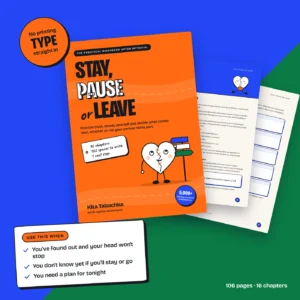
Stay, Pause or Leave was written so every chapter has a solo route. Page 14 is the one-page plan above. Chapter 16, Your Own Life, is written for the person doing this alone: when you are doing this alone (page 91), rebuild trust in your own judgement (page 92), make room for life beyond the relationship (page 93). Five pages are free, including the one-page plan.
A fictional example
Dan’s wife said the affair was over and there was nothing to discuss. He stopped waiting. He wrote down what he knew, what he needed to protect, and who he would tell. Three weeks later the conversation still had not happened, and he had a plan with no dependence on it.
Where this stops
Working alone is a route, not a verdict on the relationship. If you are frightened of your partner, if your device is monitored, or if you cannot function day to day, the next step is a person: a domestic abuse service, your GP, or a therapist. Nothing here replaces those.
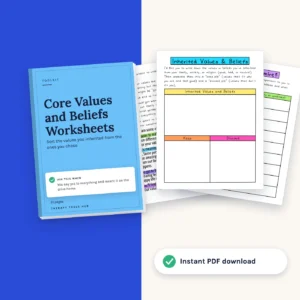
Core Values and Beliefs Worksheets: 31-Page Toolkit
Questions people ask
Does a betrayal workbook work if my partner will not do it with me?
Yes, for most of the work. Sorting what you know from what you fear, working out what you need, deciding your next step, planning for your own safety and money, and looking after your own life need nobody else. Repair pages need two people. The decision about whether repair is possible is yours alone.
My partner says the affair is dealt with and refuses to discuss it. What do I do?
Treat the refusal as information and write it down with the date. Then decide what you would need to see over the next month to believe change is happening, and watch for it rather than asking for it. If nothing comes to mind, the decision chapter of the workbook helps you weigh the blank.
How do I rebuild trust on my own?
You cannot rebuild trust in another person by yourself. Their actions over time do the building, and you judge the evidence. What you rebuild alone is trust in your own judgement, which betrayal damages badly. A record with dates, one decision at a time, and a life outside the relationship all restore it.
When should I stop using a workbook and see someone?
When you are not eating or sleeping, when checking has taken over your evenings, when children are affected, or when you feel afraid of your partner. Fear comes first and belongs with a domestic abuse service. The others belong with a GP or a therapist, and a workbook still helps alongside.
- Makinen, J. A. and Johnson, S. M. (2006). Resolving attachment injuries in couples using emotionally focused therapy: steps toward forgiveness and reconciliation. Journal of Consulting and Clinical Psychology, 74(6), 1055 to 1064.
- Snyder, D. K., Baucom, D. H. and Gordon, K. C. (2007). Getting Past the Affair. Guilford Press.
- NHS: Sexual health services. nhs.uk
More on this topic: relationship and attachment workbooks.