
His hand lands on your back in the kitchen and your whole body goes still. Not because you want him to stop, and not because you want him to continue. Because the hand has become a question, and you do not know the answer, and now you have to give one before the kettle boils.
- After betrayal, touch turns into a test: of forgiveness, of whether you still compare, of whether it is over at all. Tests fail. Take the test out of the bed first.
- Your body belongs to you. Wanting comfort without wanting sex is allowed, and so is consenting to one thing and declining the next.
- The most useful agreement in the first months: closeness with no escalation plan. A hand, a sofa, a film, and no step two.
Sex after betrayal is the part nobody writes about honestly, so couples improvise, and the improvising goes one of two ways. Some couples have more sex than they have had in years, urgent and tearful, and one of them wakes up feeling used by their own body. Others stop entirely, and every night the untouched gap in the bed becomes another conversation not had. Both are attempts to answer a question with the body which the body cannot answer: are we going to be all right?

What has touch become?
Before you talk about it, name it. Tap the line closest to your last two weeks.
What is touch doing right now?
Every touch you allow reads as absolution and every one you decline reads as a sentence. Neither is true, and the page for this is page 57, Closeness which does not become a test. Say it out loud once: touch is not my verdict on the relationship. Then take one form of touch, holding hands, and put it outside the verdict entirely.
You perform, or you avoid, and either way someone else is in the room. This is the compared or replaced page (page 59). The comparison is a fear, not a fact your partner holds. A fear is answered by your own preferences becoming visible to you again, not by performance.
Sex as proof of an ending, of being chosen, of the other person being here. It works for an hour, like any reassurance. Page 55, When reassurance starts to feel like pressure, is about both people: the one asking and the one who has started to dread the asking.
Then it waits, and waiting is not a punishment. Say the decline in one sentence, without a debate: I do not want sexual contact now. I need my answer respected without persuasion. If you ever need to say it and it is not respected, you have a safety matter, not a sex matter, and the support page comes first.
Your body belongs to you
Two things are true at once and people find the second hard. First, nobody owes anyone sex, and betrayal changes nothing about it in either direction: the person who was deceived does not owe closeness as a sign of forgiveness, and the person who broke the agreement does not owe it as penance. Second, wanting comfort is not the same as wanting sex, and you are allowed to want one without the other. I want to be held and I do not want more. I consent to one thing and decline the next. My partner has the same freedom. Those three sentences, from page 97 of the workbook, do more for a couple’s bed than any technique.
Closeness with no escalation plan
The single most useful agreement I give couples in the months after discovery is this: some touch with no step two. Not as foreplay, not as a warm-up, not as a test of readiness. A hand held on the sofa which is going to stay a hand held on the sofa. Tap each card for how it works.
Choose one form of touch
Choose one form of touch
Hands, a head on a shoulder, lying in the same bed with no expectation. One thing, named, agreed by both. Everything else is off the table for now, which is what makes the one thing possible.
Say the no-step-two out loud
Say the no-step-two out loud
This is not going anywhere tonight, and I want it anyway. Said by either person. It removes the question from the hand, and the stillness in the kitchen goes with it.
Let want return on its own
Let want return on its own
Desire after betrayal is responsive: it follows safety, it does not lead. Weeks of touch with no demand attached give it somewhere to come back to. Pushing for it earlier pushes it further away.
Review, do not test
Review, do not test
Once a fortnight, one question each: what has felt all right, what has not. No scoring, no comparing with before. If one of you is dreading the review, that is the review.

Words for the moment itself
You go still and say nothing.
I like that. Keep it there, and no further tonight.
Names the yes and the limit in one breath. The other person gets a clear answer instead of a body they have to read.
Not now. (Then a debate.)
I do not want sexual contact now. I need that to be respected without persuasion or punishment.
Page 98 of the workbook. Complete in itself. A no which has to be defended is not being heard as a no.
I just want to feel close to you again.
I will follow your pace on this and I will not make my need the reason you say yes.
Responsibility includes the bed. The person who caused the harm carries their own longing without handing it over as pressure.
When touch needs a professional, not a page
If there was sexual contact outside the relationship, a sexual health check for you comes before any of this, and the NHS sexual health service is free and confidential. If touch has been demanded, if a no has been overridden, or if you feel afraid to decline, you do not have a sex problem or a workbook problem: National Domestic Abuse Helpline, 0808 2000 247. And if the two of you keep arriving at the same wall, a couples therapist is the right room. I see couples online, including partners in different countries, and the first consultation is free.
The pages for this
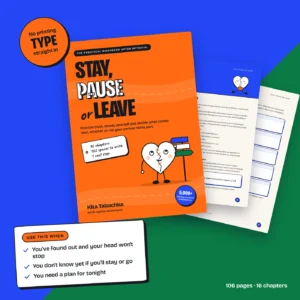
Chapter 8 of Stay, Pause or Leave is the intimacy chapter: your body belongs to you (page 54), when reassurance starts to feel like pressure (page 55), closeness without an escalation plan (page 56), closeness which does not become a test (page 57), make your preferences visible to yourself (page 58) and when you feel compared or replaced (page 59). Five pages are free to read first.
A fictional example
After the discovery, every touch from Aisha’s husband felt like an audition. She said the sentence from the workbook once: I want comfort and not sex tonight, and I need you to respect it without persuasion. He held her hand and left it there. It was the first evening in a month to end without an argument.
Where this stops
If sexual contact after betrayal involves pressure, threats or anything you did not agree to, it is not a communication problem and a script will not fix it. A sexual health service covers testing after possible exposure. A domestic abuse service covers fear. This page is educational.


Attachment and Abandonment Workbook: 70+ Exercises
Questions people ask
Is it normal to not want sex after my partner's affair?
Yes. Touch after betrayal often turns into a test of forgiveness or desirability, and bodies do not perform well under tests. Wanting comfort without wanting sex is common and allowed. Desire after betrayal tends to return in response to safety over weeks, not in response to pressure.
Why do some couples have more sex right after discovering an affair?
Urgent sex after discovery is usually an attempt to answer are we all right with the body. It brings relief for an hour and often leaves one partner feeling used by their own choices afterwards. Naming what the sex is for, and agreeing some closeness with no step two, steadies it.
How do I say no to sex without starting an argument?
One sentence, complete in itself: I do not want sexual contact now, and I need my answer respected without persuasion or punishment. A no which has to be defended is not being heard as a no. If a no is overridden or you feel afraid to say it, you have a safety matter, and it belongs with a domestic abuse service.
What is closeness with no escalation plan?
An agreement to have one form of touch, such as holding hands or lying in the same bed, with no step two and both people saying so out loud. It removes the question from every touch and gives desire somewhere safe to return to over time.
- Basson, R. (2000). The female sexual response: a different model. Journal of Sex and Marital Therapy, 26(1), 51 to 65.
- Nagoski, E. (2015). Come As You Are. Simon and Schuster.
- Snyder, D. K., Baucom, D. H. and Gordon, K. C. (2007). Getting Past the Affair. Guilford Press.
- NHS: Sexual health services. nhs.uk
More on this topic: relationship and attachment workbooks.