
It is 11pm and you have asked the same question four times. Each answer is a little smoother than the last. By the fourth you know the shape of the reply before it arrives, and you still ask, because the alternative is going to bed with the question still open.
- After betrayal, most questions get a soothing answer, not a true one. The fix is fewer questions with a clear purpose, asked once, with the answer written down.
- A question has a purpose when the answer changes a decision about your health, your money, your children or your next step.
- Checking the phone every evening is a symptom of missing information, not a character flaw. The record on paper does the job the checking is trying to do.
People ask me how to ask for the truth after betrayal as if there were a magic sentence. There is not. There is a distinction which changes everything: the difference between a question with a purpose and a question the fear keeps asking. The first kind gets you information you use. The second kind gets you reassurance which lasts until the next silence.

Which question is this?
Before you ask anything tonight, sort the question. Tap the line closest to what you want to say.
Which question is on your lips?
This has a purpose. The answer affects your sexual health, so it needs a straight yes or no, and if the answer is yes, a sexual health check for you regardless of what else happens. Ask it once, in daylight, and write the answer down with the date. If the answer changes later, the change is the information.
This one belongs to the fear. No answer settles it, because the question is not about the other person. It is about whether you are still wanted. Write it in a note instead of asking it, and take the underlying need, to be wanted, to page 59 of the workbook, When you feel compared or replaced.
Purpose. Continuing contact decides whether repair is even on the table. Ask for specifics: has the number been blocked, what happens at work, what happens if they message. Then watch what happens over two weeks. A promise is not the evidence. The two weeks are.
Purpose, and urgent. Ask for statements rather than a number from memory. If joint money moved, call your bank’s fraud or vulnerability team and get independent debt advice before you agree to any repayment plan.
Both. An honest why is useful later, when you decide whether change is possible. In the first week it produces a defence, not an explanation. Park it. Ask it on page 25 of the workbook, An explanation which leads somewhere, once the facts are in.
The four rules for a question which gets a true answer
Ask once, in daylight
Ask once, in daylight
A question asked at midnight, for the fourth time, gets the answer which ends the conversation fastest. Ask it once, sitting down, with a pen. Then stop. If the answer is thin, write down what was thin about it and ask again in two days, not two minutes.
Ask for specifics, not feelings
Ask for specifics, not feelings
Not: do you still love me. Instead: when did contact end, on which phone, and what is the plan if they message again. Feelings are easy to say and impossible to check. Specifics get checked by time.
Write the answer down
Write the answer down
A record with dates does the work the 2am checking is trying to do. Date, what was said, what remains open. When the story shifts, you see the shift on paper instead of doubting your own memory.
Decide what you will do with the answer before you ask
Decide what you will do with the answer before you ask
If the answer is yes, then what? If you do not know, the question is not ready. This single rule cuts most questions in half and makes the remaining ones count.
What to say when you ask
You do not need a speech. You need one sentence which names the purpose and asks for the specific. Tap each card for the version to use.
Just tell me everything. All of it. Now.
I need a direct answer to this because it affects my health. Please separate what you know from what you are unsure about.
Names the purpose, asks for a specific, and gives the other person a way to say I am not sure without lying. That last part matters. A person who cannot say I am not sure will fill the gap with something smooth.
If you loved me you would have told me.
I am keeping what is known separate from what is not. The uncertainty matters, and I am allowed to make choices in response to it.
Says where you stand without asking the other person to make you feel better. Reassurance is their exit. Information is yours.
Show me your phone.
I am not going to police your phone. I am going to watch what happens over the next month and decide from that.
Monitoring turns you into a guard and turns the relationship into a prison for both people. Evidence you gather by watching is evidence you trust. Evidence you gather by searching keeps you searching.

When checking becomes your whole evening
A woman I will call Dana (a fictional example, as every example here is) told me she checked her partner’s location eleven times between dinner and bed. Each check bought her ninety seconds. Then the next one was due. The checking was not madness. It was a search for information she had never been given, run through the only channel she had.
The way out is not to check less through willpower. It is to get the information a different way. A written record of what is known and what remains open, kept somewhere private, gives the searching part of you somewhere to put its work. Most people who keep the record for two weeks tell me the checking dropped on its own, because the record answered the question the checking was asking: what do I know for certain?
Two limits. If your partner has threatened you, controls your money or your movements, or you think your device is monitored, questions wait and safety comes first: the National Domestic Abuse Helpline is 0808 2000 247 and Refuge Tech Safety explains how to use a safer device. And if the checking has spread into your sleep and your work, a person in the room gets you further than any page.
The pages for this
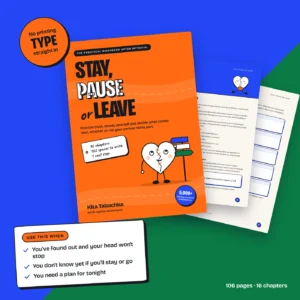
Chapter 2 of Stay, Pause or Leave is the truth chapter: what do I need to know (page 16), room for an honest account (page 17), when checking becomes your whole evening (page 18), a question with a clear purpose (page 19), and the record page (page 21). Five pages of the workbook are free to read before you decide.
A fictional example
Mira asked her husband on the first night: how many times? He said twice. A week later it was four. The number was never the question she needed answered. The question with a purpose was whether contact had stopped, and how she would know. She asked it once, in writing, and kept the reply.
Where this stops
If asking questions puts you at risk of threats, control or violence, safety comes before truth. Contact a domestic abuse service before any conversation. This article is educational and is not a substitute for therapy or legal advice.
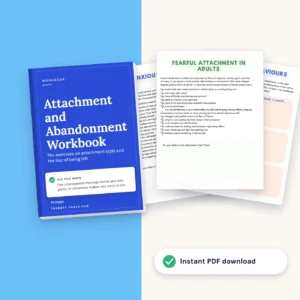
Attachment and Abandonment Workbook: 70+ Exercises
Questions people ask
How do I get my partner to tell me the truth after an affair?
You cannot force honesty, and pressure at midnight usually produces a smoother story, not a truer one. What works better: ask fewer questions, each with a clear purpose, ask once in daylight, ask for specifics rather than feelings, and write the answer down with the date. Time and consistency then show you whether the account holds.
Should I ask for every detail of the affair?
Only details which change a decision have a purpose: sexual health, money, continuing contact, children. Details which compare you to the other person rarely help and often add images you cannot remove. Sort each question by what you would do with the answer before you ask it.
Is it normal to keep checking their phone after betrayal?
Checking is a search for information you have not been given. It is common and it is exhausting, and it keeps the relationship in a guard and prisoner shape. A written record of what is known and what remains open gives the searching part of you a better tool, and most people find the checking drops once the record exists.
What if the story keeps changing?
A changing story is information in itself. Keep the record with dates and note each change. Repair needs an account which holds still. An account which keeps moving tells you something about the attempt, and the workbook’s decision chapter helps you weigh it.
- Snyder, D. K., Baucom, D. H. and Gordon, K. C. (2007). Getting Past the Affair: A Program to Help You Cope, Heal, and Move On, Together or Apart. Guilford Press.
- Gordon, K. C., Baucom, D. H. and Snyder, D. K. (2004). An integrative intervention for promoting recovery from extramarital affairs. Journal of Marital and Family Therapy, 30(2), 213 to 231.
- Refuge Tech Safety: guidance on monitored devices and safer technology. refugetechsafety.org
More on this topic: relationship and attachment workbooks.