
Your sister wants an answer by Sunday. Your partner wants one tonight. A friend has already told you what she would do, and a second friend has told you the opposite. You have not eaten a full meal since Tuesday, and everyone around you is treating a decision about the rest of your life as if it were overdue.
- Urgent decisions (health, money, children, safety) and the lasting decision (stay or leave) are different decisions. Make the urgent ones now and give the lasting one a date.
- Limbo is a pause with no arrangements and no end. A supported pause has both, written down.
- Say it in one sentence: I am not ready to choose repair or separation today. Here is what I need for now, and here is when I will review.
Knowing how to pause a relationship decision is a skill nobody teaches, so people do one of two things. They decide fast, from the worst week of their life, and reopen the decision every night for a year. Or they do not decide at all, and the not-deciding stretches into a grey second relationship where nothing is agreed and everything is argued. There is a third option, and it has a structure.

Is your pause supported, or is it limbo?
Five questions. Answer for the last two weeks.
Pause or limbo?
Answer honestly. Nobody sees this but you.
Separate the urgent from the lasting
The mistake most people make is to put every decision in one pile. Split it. Tap each card.
Urgent, this week
Decide now.
Urgent, this week
Sexual health check if there was sexual contact. Protect money you cannot afford to lose. Children's routine and what they are told. Safety if you feel afraid. Contact with the third person. None of these wait for the big decision, and none of them decide it.
Lasting, on a date
Decide later, on purpose.
Lasting, on a date
Whether you will live, forgive or stay with this person next year. This decision made from the worst week of your life gets remade every night. Give it a date four to eight weeks away and refuse to reopen it before then.
Not yours to decide
Let it go.
Not yours to decide
Whether your partner will change. Whether they meant it. What the other person wanted. You can watch for evidence. You cannot decide these by thinking harder, and trying to keeps you awake.
Write the pause plan
A supported pause is four things on one page. It takes an hour, and you do it alone if your partner will not sit down.
Arrangements
Arrangements
Where each of you sleeps. What happens with money in the meantime. What the children are told and by whom. Whether the third person is contacted and what happens if they make contact. Specific enough to be checked.
Information you need
Information you need
What you need to know before the review, and who provides it. Statements, a straight answer about contact, a sexual health result. If it needs your partner and they refuse, note the refusal as part of the review.
Support
Support
One person who knows the plan. A GP if you are not sleeping. A therapist if you want one. A pause without support becomes a pause spent explaining yourself to people who want a verdict.
The review date
The review date
Four to eight weeks, in the diary, said out loud. At the review you ask two questions: what has changed, and what remains unresolved. Then you decide again, or pause again, with a new date.

Say your pause clearly
People fear the pause conversation because they think it needs a defence of their whole history. It needs one sentence. The workbook gives four, one for each direction. This is the pause one.
I don't know what I want. Stop asking me.
I am not ready to choose repair or separation today. For now, I need these practical arrangements and this support. I will review what is helping and what remains unresolved on the fifteenth.
Names the state, names the needs, names the date. It gives the other person something to do and takes the nightly question off the table.
You don't understand, it's complicated.
I know you care about what happens. What helps me most now is practical support and room to make my own decision.
From page 98 of the workbook. It thanks the friend for the care and declines the verdict in the same breath.
A woman I will call Priya (fictional, like every example here) set a six-week review after discovering her husband’s gambling debt. The arrangements: separate accounts, statements shared weekly, a debt adviser booked. At six weeks the statements were clean and the adviser had a plan. She paused again, twelve weeks this time. At the second review she chose repair, from evidence rather than hope. The pause did not delay the decision. It made one.
The pages for this
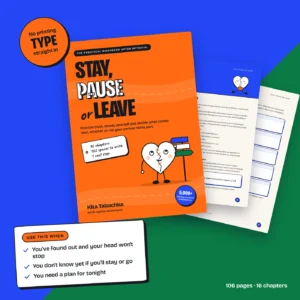
Chapter 4 of Stay, Pause or Leave is the decide chapter: you have more than one decision (page 28), hear your own view among the advice (page 29), what your options require (page 30), a pause with a purpose (page 32), a supported pause plan (page 34) and saying your decision clearly (page 35). Read five pages free first.
A fictional example
Nina told her partner she needed six weeks. They agreed who slept where, how the children’s week ran, and a date to speak again: the fourteenth of the month. The pause held because it had edges. The earlier pause, the one with no date, had lasted eleven months.
Where this stops
A pause needs enough safety for both people to keep to it. Where there is coercion, financial control or fear, a pause is not available and specialist advice is. This is education, not therapy or legal advice.
Understanding Conflict Workbook: Work and Relationships
Questions people ask
Is it okay to not decide whether to stay after an affair?
Yes, if the not-deciding has a structure. A supported pause has practical arrangements, the information you need, one person who knows the plan, and a review date in the diary. Without those it becomes limbo, where the decision is reopened every night and nothing is agreed.
How long should a pause last?
Four to eight weeks for a first review. Long enough to see whether promises become visible change, short enough to keep the question from drifting. At the review you decide, or pause again with a new date. Repeated pauses with no change are themselves information.
What if my partner refuses a pause and demands an answer?
You do not need their agreement to pause your own decision. Say the sentence once, in daylight: I am not ready to choose today, here is what I need for now, here is when I will review. Then stop answering the nightly question. Their response to the pause tells you something about the repair they are offering.
Can a pause include sleeping apart?
Yes. Sleeping arrangements are one of the practical decisions a pause settles, and settling them stops them being renegotiated every night. Write down where each of you sleeps until the review date, and treat it as fixed until then.
- Snyder, D. K., Baucom, D. H. and Gordon, K. C. (2007). Getting Past the Affair. Guilford Press.
- NICE (2025). Gambling-related harms: identification, assessment and management, NG248. nice.org.uk/guidance/ng248
- MoneyHelper: free debt advice locator. moneyhelper.org.uk
More on this topic: relationship and attachment workbooks.