
It is ten to seven in a flat on The Pearl. You slept two hours, perhaps less. Your daughter stands at the counter with one shoe on and asks why Baba slept on the sofa. The school bus leaves in twenty minutes. Your face holds steady. Your hands shake on the zip of her book bag.
Last night you found out about the affair. This morning a different question sits on top of all the others: what do I tell the children, and does the school need to know?
- Children need the truth about the change at home, not the details of the affair. Adult information stays with the adults.
- If both of you are able to stay calm, tell them together, with words agreed beforehand.
- If you are afraid of your partner, or your phone or money is being watched, go to the safety section below first.
What children notice before you say a word
Children read a home like weather. They notice the closed bedroom door, the clipped voices in the kitchen, the phone turned face down on the table. In an expat family the signals land harder. With family a long flight away, the household becomes the whole world.
Your own body is under pressure too. Sleep breaks into pieces. The chest stays tight through the school run. A nervous system on high alert pushes towards two extremes: tell the children everything tonight, or act as if nothing has happened. Neither serves a child.
Shame follows. Shame for moving the family to Doha, for missing the signs, for crying in the car park. Put responsibility where it belongs. The affair was your partner’s choice. Your task now is narrower and kinder: keep the children steady while the adults work out what comes next.

What to say, and what stays between adults
Research on separating families, including Robert Emery’s, points one way. Children cope better with honest, age-fitting information and steady routines. They struggle most when pulled into adult conflict or pressed to choose a side.
So hold two things apart. The change at home belongs to the children too, because they live in it. The affair belongs to the adults. A teenager given the details by one parent carries a loyalty burden no young person should hold.
Tap each card for words matched to your child’s age.
Under seven
Short, concrete, about routine
Under seven
Mum and Dad are sad and are sorting out a grown-up problem. It is not because of anything you did. You go to school tomorrow and I will be here when you get home.
Seven to twelve
Name the feeling, keep the details private
Seven to twelve
We are going through a hard time as a couple. This is ours to sort out, not yours. Ask us anything. If an answer is for grown-ups only, we will tell you so, and we will never lie to you about it.
Teenagers
Honest about the change, private about the adult part
Teenagers
Things between us are difficult right now and we are getting help. Some parts are private between us as a couple. Come to either of us, any time. You never have to take a side.
A script for the first conversation
If you are both able to stay calm in the same room, tell the children together. Keep it under five minutes, then move to something ordinary, such as dinner or a walk along the Corniche.
We want to tell you something important. Mum and Dad are going through a difficult time as a couple. It is a grown-up problem and it is not your fault. We both love you. School, your friends and your routines stay the same this week. Ask us anything, any time.
Say it once, then let the silence work. Answer the question your child asks, not the one you fear. If a child asks whether you are getting divorced, an honest reply is: we have not decided anything, and when we know more, we will tell you.
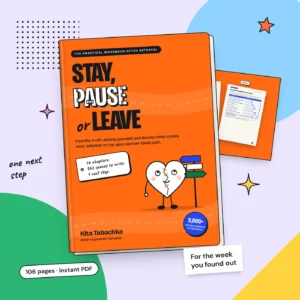
The Children chapter of Stay, Pause or Leave: The Practical Workbook After Betrayal helps you plan these conversations before you have them, alongside the Steady chapter for your own first days. If you are not ready to decide anything about the relationship, read how to pause a relationship decision after an affair without living in limbo.
Does the international school need to know?
Many international schools in Doha have a counsellor or pastoral lead. A short note to the class teacher or counsellor helps staff read a change in behaviour with care. One line is enough: our family is going through a difficult time at home, please let us know if you notice changes in our son’s mood or behaviour.
The word affair never needs to appear in a school email. Parents’ WhatsApp groups move fast, so keep the note to staff and ask for confidentiality.
A fictional example
Maya is a composite, not a real person. She lived in Al Waab with her partner, their son of nine and their daughter of fourteen. She found the messages on a Wednesday night and her first urge was to tell the children everything. She waited. On Thursday she and her partner said four agreed sentences together at dinner. Her daughter asked for details. Maya told her some parts were private and she would never be asked to pick a side. On Sunday she emailed the school counsellor two lines. Nothing about the marriage was decided. The children slept through the night.
Practical checks before bigger steps
If separation crosses your mind, slow the decision and speed up the advice. British Embassy guidance explains Qatari courts decide custody under Sharia-based family law, whatever the parents’ religion. Residence for a sponsored spouse, the children’s sponsorship and travel each follow their own rules, and outcomes depend on nationality. Speak to a lawyer licensed in Qatar, and contact your own embassy, before you move out, move money or travel with the children. This page is education, not legal advice.
When education is not enough
If you are afraid of your partner, if your phone, passport or money is being watched or controlled, if there has been violence or the threat of it, or if you are thinking of harming yourself, stop reading and reach for help now. If a child is at risk, their safety comes before any plan about what to tell them.
In Doha, call 999 in an emergency. Aman, the Protection and Social Rehabilitation Centre, runs the 919 hotline around the clock for women, children and people facing family violence, with help offered in several languages including Arabic, Urdu, Tagalog and French. The National Mental Health Helpline, run by Hamad Medical Corporation, answers on 16000, option 4, from 8am to 6pm, Saturday to Thursday. If your phone is monitored, call from a friend’s phone and clear this page from your history.
Kita Tabachka is a BACP registered relational therapist (registration 409623) who works online with individuals, couples and expats.
Questions people ask
Should I tell my children about my partner's affair?
Tell them about the change at home in words fitted to their age, and keep the affair itself between the adults. Children need to hear they are loved and it is not their fault.
Should I tell my child's international school in Doha?
A short note to the teacher or counsellor helps staff support your child. Share the change, leave out the details, and ask for confidentiality.
What if my teenager already knows about the affair?
Acknowledge what they know without adding detail. Tell them it is not theirs to fix and they never have to choose a side. A school counsellor gives them a private place to talk.
- British Embassy Doha. Family law in Qatar. gov.uk
- Qatar Tribune. Aman launches campaign to raise awareness of 919 hotline services. qatar-tribune.com
- Qatar Tribune. National Mental Health Helpline handled over 19,000 calls in 2025: HMC. qatar-tribune.com
- Emery, R. E. (2011). Renegotiating Family Relationships: Divorce, Child Custody, and Mediation (2nd ed.). Guilford Press.
Your next step today: write down the three sentences you want your children to hear, in words fitted to their age, before tonight’s bedtime.