
Forty minutes in, the client has described the argument with her mother, the argument with her sister about her mother, and the message her sister sent afterwards. You have nodded, reflected, summarised. The clock says ten minutes left. Nothing has moved.
- Solution focused therapy questions turn a client towards exceptions, resources and the next small step without dismissing the problem.
- Four questions do most of the work: exception, scaling, coping and the miracle question.
- Write three questions at the top of your notes before the client arrives, chosen for the client in front of you.
Solution focused therapy questions exist for this minute. They do not dismiss the problem. They turn the client to face a different direction: towards the times the problem was smaller, the resources already in use, and the next small step. Steve de Shazer and Insoo Kim Berg built the approach in Milwaukee in the 1980s on one observation. Clients talked about problems for hours and about solutions for seconds, and the seconds were where change lived.

Spot the solution-focused question
Five sets of three. One question in each set faces the solution. Pick it.
Four questions, in the order they tend to work
Tap each card for the question, and what it did in one session.
The exception question
When did this not happen?
The exception question
'In the last month, when did an argument with your mother not happen, or end sooner than usual? What was different?' She remembers a Sunday when she called from the car and had a reason to hang up. The exception holds the solution: a time limit.
The scaling question
Where are you today, zero to ten?
The scaling question
'Zero is the worst it has been, ten is the relationship you want. Where are you today?' She says four. 'What would five look like?' One call a week which stays calm. Now there is a target for the next seven days.
The coping question
How have you kept going?
The coping question
'With all of this going on, how have you kept turning up to work every day?' The question refuses the story of helplessness without arguing with it. Clients name three things they have been doing to hold together, and hear themselves say them.
The miracle question
Suppose it was solved overnight.
The miracle question
'Suppose tonight, while you sleep, the problem is solved, and nobody tells you. What is the first thing you notice tomorrow morning?' The answers are small: I would text her back without reading it four times first. Small gets done on Tuesday.
Say this instead
Three questions which keep a client facing the problem, and the version which turns them round. Tap to swap.
Why do you think she does that?
When did she last do it less, and what were you doing?
Why questions produce theories about the mother. Exception questions produce a Sunday the client had forgotten.
How does the arguing make you feel?
On a good day with her, what do you notice first?
Feelings about the problem are well known to the client by minute forty. The good day is the new information.
What have you tried?
What has kept this from getting worse?
'What have you tried' invites a list of failures. The coping question invites a list of resources, in the client's own words.
Where is the session stuck?
Ask the exception question. ‘When in the last fortnight was this smaller?’ Problem talk has momentum, and the exception question is the only one which changes direction without dismissing what came before.
Ask the coping question. ‘Given all of this, how have you managed to get here today?’ The client who says nothing works has been doing something for weeks. Name it with them.
Ask the scaling question, then ‘what would one point higher look like?’ The client supplies the advice in their own words, which is the only advice people follow.
Ask the miracle question and stop after the first small answer. Write it at the top of next week’s notes. The last ten minutes become the part of the session the client remembers on the drive home.

Why the questions work
Attention follows the question. Forty minutes of problem description keeps the client’s attention on what is wrong, and attention on what is wrong produces more of what is wrong. A question about an exception moves attention to a moment when the client was already competent. The 2013 review by Gingerich and Peterson of 43 studies on solution-focused brief therapy found most reported significant positive benefit, often in fewer sessions than comparison treatments.
Prepare three before the client arrives
Write three questions at the top of your notes before each session, chosen for the client in front of you. When the session stalls, you have a prepared way back in, and the ten minutes at the end become the part of the session the client remembers on the drive home.
Downloads for this
A fictional example
A client had spent three sessions describing the same argument with her sister. The exception question changed the room: when was the last week the argument did not happen, and what was different? A holiday, it turned out, with no shared kitchen. The session moved from the argument to the kitchen.
Where this stops
Solution-focused questions suit clients with some capacity to picture change. They are a poor fit in acute crisis, in active risk, or where a client needs to be heard at length before being asked to look forward. Judgement about timing is the clinician’s, and supervision is where to test it.
800 Solution-Focused Therapy Questions

1500+ Therapy Questions for Counsellors and Therapists

1100+ Narrative Therapy Questions and Interventions

300 SMART Goals for Treatment Planning
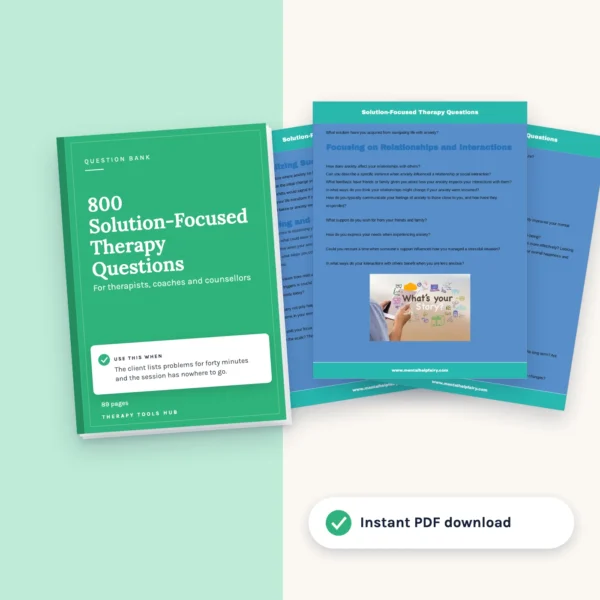
The question bank for this
800 Solution-Focused Therapy Questions
800 solution-focused questions across 89 pages, grouped by what you are trying to do in the room, with a self-help section for clients.
Questions people ask
What is a solution focused therapy question?
A solution focused therapy question turns the client’s attention from the problem towards exceptions, existing resources and the next small step. The main types are the exception question, the scaling question, the coping question and the miracle question. They come from solution-focused brief therapy, developed by Steve de Shazer and Insoo Kim Berg in Milwaukee in the 1980s.
What is the miracle question?
The miracle question asks the client to suppose the problem was solved overnight while they slept, without anyone telling them, and to describe the first small thing they would notice the next morning. The answer gives a concrete, observable goal, often something achievable within the week.
How many sessions does solution focused therapy take?
Solution-focused brief therapy is designed to be short. Many courses run between three and eight sessions. Gingerich and Peterson’s 2013 review of 43 studies found most reported significant benefit, often in fewer sessions than comparison approaches. Length depends on the client and the problem.
Does solution focused therapy work for couples?
Yes. Scaling questions and exception questions work well with couples because each partner rates the relationship and names the times it went better. The questions move the session from blame towards the specific behaviours which produced a good week, which both partners repeat.
- Gingerich, W. J. and Peterson, L. T. (2013). Effectiveness of solution-focused brief therapy: a systematic qualitative review of controlled outcome studies. Research on Social Work Practice, 23(3), 266 to 283. doi.org/10.1177/1049731512470859
- de Shazer, S. (1988). Clues: Investigating Solutions in Brief Therapy. Norton.
More for practitioners: therapy question banks.