
It is 6.40pm on Friday. Six clients today, six blank notes. You remember every session: the woman who cried at the mention of her father, the couple who argued for twenty minutes about a dishwasher and were talking about money. You know what happened. The clinical words for it have gone home without you.
- A progress note has three lines: intervention, response, plan. Fill the shape, do not compose an essay.
- Write the intervention line in the two minutes after the client leaves. The rest takes three minutes at the end of the day.
- US examples follow HIPAA. UK practitioners follow GDPR and their professional body, so copy the structure, not the rules.
This is the note problem, and it is not a memory problem. Writing a session up asks for a different skill from being in the session, and most training courses spend three years on the second and an afternoon on the first. Good therapy progress notes examples fix the gap, because they show you the shape before you fill it.

How late is your note?
Five questions. Nobody is reading over your shoulder.
Why the last note takes the longest
Each note asks for three decisions: what to call the intervention, how to describe the client’s response, and what the plan is. Six notes means eighteen decisions at the end of a day which already held two hundred. The first note takes eight minutes. The sixth takes twenty, because the deciding has run out.
The three-line note
Intervention, response, plan. Tap each line for what goes in it.
Intervention
What you did, in clinical words.
Intervention
One sentence naming the technique and its target. 'Used a scaling question to assess confidence in managing conflict with her mother.' Write it in the two minutes after the client leaves, while the session is still in the room.
Response
What the client did with it.
Response
Observable and specific. A rating, a named exception, a change in affect you saw. 'Client rated herself 4 of 10 and identified one calm call from the past fortnight.' No interpretation, no adjectives.
Plan
What happens before next time.
Plan
One action, one owner, one measure. 'Client to end the next difficult call at the first sign of escalation and record the outcome.' If the plan has no verb, it is not a plan.
Say this instead
Four lines from real notes, and the version a reviewer would sign off. Tap to swap.
Client was very upset.
Client rated distress 8 of 10 when discussing her father and 5 of 10 after two minutes of paced breathing.
Two numbers and one intervention. A reader knows what happened, what you did and whether it worked.
We talked about his childhood.
Explored early attachment experiences with the client's father using a three-generation genogram.
Names the intervention and the tool. 'Talked about' describes every session ever held.
Good session, made progress.
Client completed a thought record without prompting for the first time and identified two pieces of contrary evidence.
Progress is a claim. A first-time behaviour is a fact.
Continue as agreed.
Client to ask one colleague for help this week and log the response before the next session.
One action, one owner, one measure. The next session opens with a question already prepared.
Which session are you writing up?
Completed a thought record around the belief ‘if I ask for help I am a burden’. Client rated the belief at 90 percent before the exercise and 60 percent after, and named two pieces of contrary evidence. Plan: client to ask one colleague for help this week and log the response.
Used a scaling question to assess the client’s confidence in managing conflict with her mother. Client rated herself at 4 of 10 and identified one exception from the past fortnight, a phone call which stayed calm because she ended it early. Plan: client to end the next difficult call at the first sign of escalation and record the outcome.
Coached a soft start-up for raising the division of household tasks. Partner A opened with ‘I feel stretched on weekday evenings’ rather than ‘you never help’, and Partner B stayed in the conversation for the full ten minutes. Plan: both to use the soft start-up once before the next session and note what happened in the first minute.
Introduced the window of tolerance and mapped the client’s signs of hyperarousal and shutdown. Client identified a raised voice at home as the main trigger and named two grounding practices already in use. Plan: client to log triggers and body responses for one week using the trigger diary, with no requirement to change anything yet.
Write the intervention line before the client leaves
Keep two minutes between sessions for one line: the intervention. The response and the plan take three more minutes at the end of the day, and they come easily, because the intervention line brings the session back. Six intervention lines written during the day turn a Friday evening of twenty-minute notes into fifteen minutes of finishing.
Wording travels, rules do not
Note conventions differ by country. Examples written for the United States follow HIPAA. In the UK you work under GDPR and the record-keeping guidance of your own professional body, such as the BACP Ethical Framework, which asks for records to be accurate, secure and no more detailed than the work requires. Treat any example as a model for structure and language, then apply your own rules.
Downloads for this
A fictional example
Sam finished with a client at 6pm on Friday and left the note blank. On Monday, with the structure in front of him, he wrote three lines: what the client brought, what was worked on, what happens next. Nine minutes. The version he had been avoiding all weekend was a report. The version he needed was a note.
Where this stops
The structures here are teaching examples with fictional clients. Your notes must follow your registration body, your insurer and the law where you practise, and some settings require specific formats. Use these as a starting shape, not as a compliance standard.

300 SMART Goals for Treatment Planning
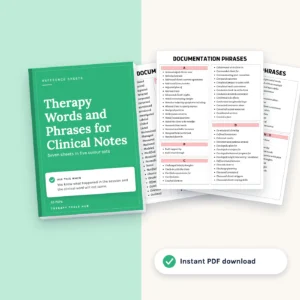
Therapy Words and Phrases Bundle for Clinical Notes
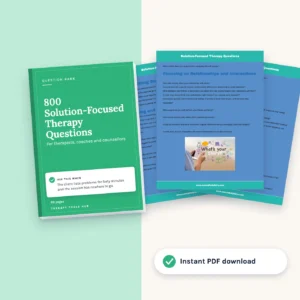
800 Solution-Focused Therapy Questions
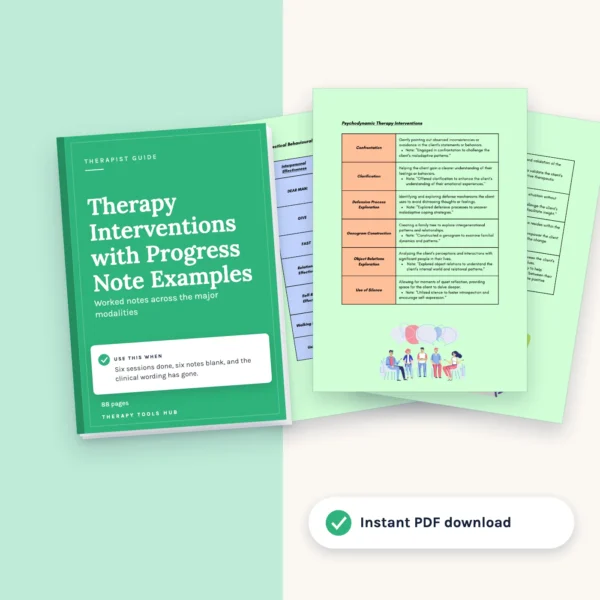
The reference for this
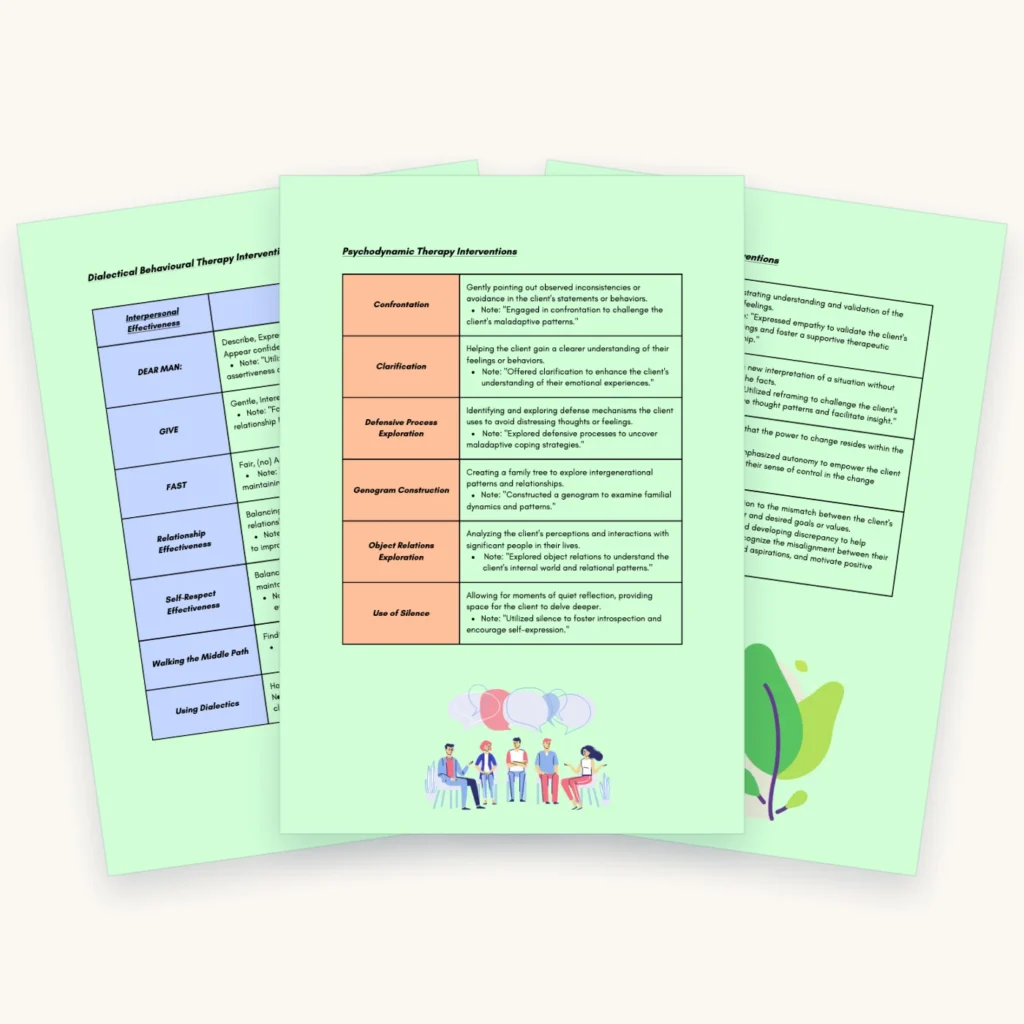
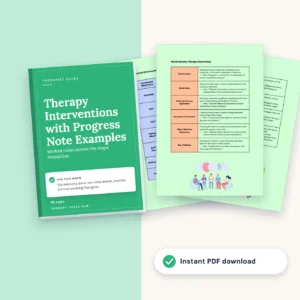
Therapy Interventions with HIPAA-Compliant Progress Note Examples
Interventions from CBT, DBT, SFBT, narrative, psychodynamic, play and family therapy, each paired with a worked progress note.
Questions people ask
What are the three parts of a therapy progress note?
Intervention, response and plan. The intervention names the technique and its target in one sentence. The response records what the client did with it, in observable terms such as a rating or a named behaviour. The plan states one action, one owner and one measure before the next session.
How long should a therapy progress note be?
Three to six sentences covers most sessions. A note needs enough detail for another clinician to understand what happened and what comes next, and no more. Records which run to a page per session take longer to write and are harder to defend under data protection rules which ask for no more detail than the work requires.
Are US progress note examples usable in the UK?
As models for structure and clinical language, yes. As rules, no. US examples follow HIPAA. UK practitioners work under GDPR and their own professional body’s guidance, such as the BACP Ethical Framework. Copy the shape of the note and apply your own record-keeping rules.
What is the difference between a progress note and a process note?
A progress note is the formal record of a session: intervention, client response and plan, written for the clinical file. A process note is the therapist’s private reflection on the work, including hypotheses and countertransference, kept separately and often not part of the disclosable record. Check your professional body’s guidance on how each is stored.
- British Association for Counselling and Psychotherapy. Ethical Framework for the Counselling Professions. bacp.co.uk
- Information Commissioner’s Office. Guide to the UK GDPR. ico.org.uk
More for practitioners: progress notes and treatment planning.