
The records request arrives on a Tuesday. A solicitor wants two years of session notes for a client you saw during a custody dispute. You open the folder. Half the notes are in the practice system, a quarter are in a Word file called notes_final_2, and the rest are in a notebook in the car.
- A session template is a shape for your thinking. The client record is a different thing, and it lives inside compliant software, never inside a downloaded PDF.
- Templates from this shop hold no client data: they arrive by email, you print or fill them, and the record stays in your system.
- Three lines per session (intervention, response, plan) satisfy most auditors, most supervisors and most Friday evenings.
Therapy session templates fix the folder problem before it starts. A template decides what gets captured every time, so the sixth note of the day has the same shape as the first. What a template must never do is hold the record itself. The record belongs in software built for it, with encryption, access logs and a retention schedule. In the United States this means a HIPAA-compliant system. In the UK it means one which meets GDPR and your professional body’s guidance. The template is the scaffold. The system is the vault.
What goes where
Tap each card. The split is the whole compliance argument.
The template
A shape, printed or on screen
The template
Headings, prompts, a scale to circle, a plan line. No client name, no identifiers, no history. You download it once and use it a thousand times.
The record
Inside compliant software
The record
The completed note with the client's name, date and content. Stored in a system with encryption at rest, role-based access and an audit trail. Never in a PDF, never in email, never in a notebook in the car.
The question bank
Preparation, not documentation
The question bank
Questions you mark before a session and adapt in the room. They shape the work. They hold nothing about the client, so they live anywhere, including your kitchen table.
Where do you practise?
HIPAA governs the record. Templates support preparation and structure, and the finished note goes into a HIPAA-compliant EHR with a signed business associate agreement. Keep the template generic and the record specific, and the two never meet on an unsecured device.
UK GDPR and your professional body set the rules. The BACP Ethical Framework asks for records which are accurate, secure, and no more detailed than the work requires. A three-line note meets the last of those better than a page of prose.
The Privacy Act and your association’s code apply, and the principle holds: templates are yours, records are the client’s, and the record needs a system with access control and a retention rule. Copy the structure from any template, then apply your own rules.
The three-line note, again
Intervention: the technique and its target, in one sentence. Response: what the client did with it, in observable terms. Plan: one action, one owner, one measure before next time. Written this way, a note takes four minutes and reads clearly to a supervisor, an auditor or a solicitor two years later. The progress notes article has worked examples across CBT, solution-focused, couples and trauma sessions.
What a template does for a tired brain
Six notes at 6.40pm on a Friday means eighteen decisions about wording. A template removes them. The headings are already there, the scale is already drawn, and the plan line is already waiting for a verb. Practitioners who switch to a fixed shape report the same thing: the notes get shorter, the backlog disappears, and supervision stops being about documentation.
Downloads for this
A fictional example
Priya sees six clients on a Tuesday. Her planning sheet for the 2pm session reads: theme, last week’s homework, one question to open with, one thing to watch for. No name, no date of birth, no employer. The clinical record in her practice software holds the rest. When the sheet falls out of her bag on the train, nothing on it identifies anyone.
Where this stops
A planning template organises your thinking. It is not a substitute for the clinical record your registration body and insurer expect you to keep, and it does not replace supervision. Check your own professional requirements before you change how you record anything.
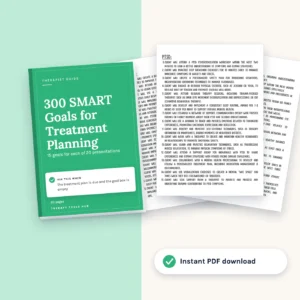
300 SMART Goals for Treatment Planning
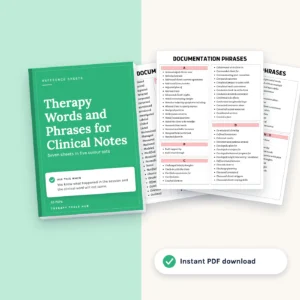
Therapy Words and Phrases Bundle for Clinical Notes
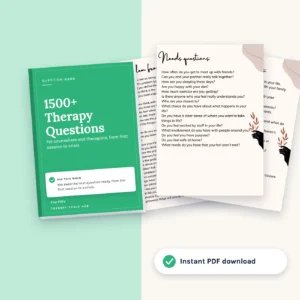
1500+ Therapy Questions for Counsellors and Therapists
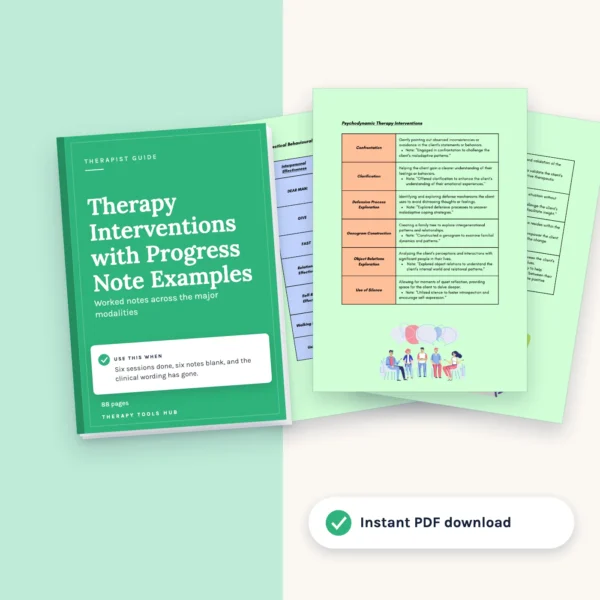
The reference for this
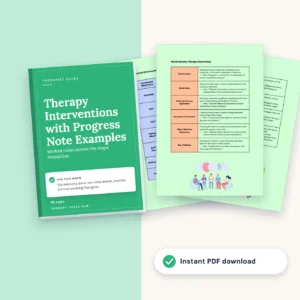
Therapy Interventions with HIPAA-Compliant Progress Note Examples
Interventions from CBT, DBT, SFBT, narrative, psychodynamic, play and family therapy, each paired with a worked progress note.
Questions people ask
Are session templates from a shop HIPAA compliant?
A blank template holds no protected health information, so compliance does not apply to the template itself. Compliance applies to where you store the completed note. Use the template for structure and keep the finished record in a HIPAA-compliant system with a business associate agreement.
Is it safe to keep completed notes as PDFs on my laptop?
Only if the device and the files meet your jurisdiction’s rules for encryption, access and retention, and most do not. Practice management software built for clinical records is the safer route. The template stays on your laptop, the record does not.
What should a therapy session template include?
Date and session number fields, presenting issue, intervention, client response, risk check, plan, and a signature line. Three lines cover the clinical core: what you did, what the client did with it, and what happens before next time.
Do I need different templates for different modalities?
No. The three-line structure works across modalities. What changes is the wording of the intervention line: a thought record in CBT, a scaling question in solution-focused work, a soft start-up in couples therapy.
- U.S. Department of Health and Human Services. Summary of the HIPAA Privacy Rule. hhs.gov
- British Association for Counselling and Psychotherapy. Ethical Framework for the Counselling Professions. bacp.co.uk
More for practitioners: progress notes and treatment planning.